There are few kitchen disappointments quite like pouring your perfect batter into a waffle maker, only for it to remain stubbornly cold. A non-heating waffle maker can quickly derail your breakfast plans, leaving you with uncooked batter and a frustrating mystery. But before you banish it to the back of the cupboard or rush out to buy a new one, there are several common issues you can investigate. With a bit of patience and some careful troubleshooting, you might just be able to bring your beloved appliance back to life.
This guide will walk you through the most frequent culprits behind a waffle maker’s heating failure, provide essential safety precautions, and offer step-by-step instructions to diagnose and potentially resolve the problem. We’ll cover everything from simple power issues to internal component failures, helping you determine if a DIY fix is feasible or if it’s time to consider a professional repair or replacement.
Understanding Why Your Waffle Maker Might Stop Heating Up
When your waffle maker loses its warmth, the problem usually stems from one of two main categories: issues with the power supply or a failure within the appliance’s internal heating components. Understanding these potential causes is the first step toward a successful diagnosis.
Power Supply Issues
Sometimes, the problem isn’t with the waffle maker itself, but with the electrical connection.
- Faulty Power Outlet: The outlet you’re using might be defective, or a connected circuit breaker may have tripped. This is often the simplest fix.
- Damaged Power Cord or Plug: The external cord or the plug prongs can become damaged over time due to bending, tugging, or improper storage. A visible fray or a bent prong could interrupt the electrical flow.
- Tripped Circuit Breaker: If your waffle maker draws too much power, or if there’s a short circuit, it can trip your home’s circuit breaker, cutting off electricity to that specific outlet.
|
Our Picks for the Best Waffle maker in 2026
As an Amazon Associate I earn from qualifying purchases.
|
||
| Num | Product | Action |
|---|---|---|
| 1 | Dash No-Drip Waffle Maker - Quad Waffle Maker for Hassle-Free Breakfasts - Dual Nonstick Heating Plates & Quick Heat-Up System - Easy-Release Surface - Silver |

|
| 2 | Cuisinart Waffle Maker, 1250W Round Classic Waffle Iron, 5-Setting Adjustable Browning Control, WMR-CANAS, Brushed Stainless |
|
| 3 | KRUPS 4-Slice Belgian Waffle Maker: Stainless Steel, 5 Browning Levels, Audible Ready Beep, Removable Plates, 1200W, Silver/Black, Large Waffle Maker Family Size, Great for Family Breakfasts |
|
| 4 | Waffle Maker, Rotating Belgian Waffle Maker, 180° Flip Waffle Iron, Non-Stick Plate, Adjustable Browning Control, Foldable Cool Touch Handle, Removable Drip Tray, Space Saving Storage, Stainless Steel |
|
| 5 | Cuisinart Round Flip Belgian Waffle Maker, Black/Silver, 1 inch thick, WAF-F30NAS |
|
| 6 | OSTBA Waffle Maker, 2 Slice Non-Stick Waffle Iron, Belgian Waffle Machine with Indicator Lights, PFOA Free, Perfect for Breakfast and Snacks, 750W |
|
| 7 | Cuisinart Waffle Maker, 1250W Round Classic Waffle Iron, 5-Setting Adjustable Browning Control, WMR-CAP2, Brushed Stainless |
|
| 8 | Elite Gourmet EWM015MX Electric Nonstick 4.5-inch Mini Waffle Maker, Belgian Waffles, Compact Design, Hash Browns, Keto, Snacks, Sandwich, Eggs, Easy to Clean, Mint |
|
| 9 | Dash Mini Waffle Maker- Compact Electric Iron for Creative Homemade Treats - Nonstick Surface - Easy-to-Clean - Perfect for Kids & Families - Aqua |
|
| 10 | bella Classic Rotating Belgian Waffle Maker with Nonstick Plates, Removable Drip Tray, Adjustable Browning Control and Cool Touch Handles, Black |
|
Internal Component Failures
If the power supply is working correctly, the issue likely lies deeper within the waffle maker.
- Blown Thermal Fuse: This is one of the most common reasons a waffle maker stops heating. A thermal fuse is a critical safety device designed to blow (break the circuit) if the appliance overheats, preventing a potential fire hazard. If it blows, the waffle maker will not receive power to its heating element. It’s crucial not to bypass this fuse, as it indicates an underlying issue, possibly a faulty thermostat.
- Faulty Heating Element: Waffle makers rely on heating elements to generate the necessary warmth. If an element burns out or breaks, it won’t be able to heat the cooking plates. You might notice one side of your waffle maker still heats while the other remains cold, indicating a partial failure.
- Defective Thermostat: The thermostat regulates the waffle maker’s temperature, cycling the heating element on and off to maintain a consistent heat. If the thermostat fails in an “open” position, it won’t allow power to reach the heating element, preventing the unit from warming up at all. Conversely, if it fails in a “closed” position and the thermal fuse doesn’t trigger, it could lead to overheating.
- Loose or Corroded Internal Connections: Over time, vibrations or heat exposure can cause internal wires to loosen or terminals to corrode, leading to an intermittent or complete loss of power to key components.
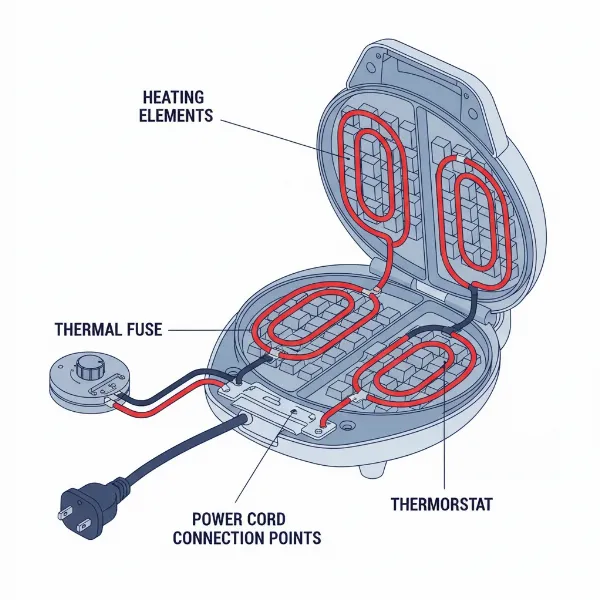 Diagram illustrating internal components of a waffle maker, including heating element, thermostat, and thermal fuse.
Essential Safety Precautions Before You Begin
Before you attempt any troubleshooting or repairs on your waffle maker, it is absolutely crucial to prioritize safety. Working with electrical appliances carries inherent risks, and improper handling can lead to electrical shock or further damage.
- Always Unplug the Appliance: This is the golden rule. Never, under any circumstances, attempt to inspect or repair an electrical appliance that is still plugged into an outlet. Disconnect it completely from the power source.
- Allow it to Cool Completely: Waffle makers get extremely hot. Ensure the appliance has had ample time to cool down before touching any of its surfaces or attempting to open it.
- Gather the Right Tools: You may need screwdrivers (Phillips and flathead), a multimeter for testing continuity and resistance, and possibly needle-nose pliers. Using the correct tools reduces the risk of damage to the appliance and injury to yourself.
- Understand the Risks: Be aware that DIY repairs on heating appliances can be complex and potentially dangerous if not done correctly. If you’re uncomfortable with electrical work or disassembling appliances, it’s safer to seek professional help or consider replacement.
- Avoid Bypassing Safety Devices: As mentioned earlier, never bypass a thermal fuse or any other safety mechanism. These components are there to protect you and your home from fire and electrical hazards.
Step-by-Step Troubleshooting for a Non-Heating Waffle Maker
Once you’ve taken the necessary safety precautions, you can begin to systematically troubleshoot your waffle maker. Start with the simplest potential issues and work your way to more complex internal inspections.
Check the Power Source
Begin by ensuring your waffle maker is actually receiving power.
- Test the Outlet: Plug another small appliance (like a lamp or a phone charger) into the same outlet your waffle maker uses. If the other appliance works, the outlet is fine. If it doesn’t, the problem might be with the outlet itself or the circuit.
- Verify the Plug is Fully Inserted: Ensure the waffle maker’s plug is pushed all the way into the wall outlet. A loose connection can prevent power flow.
- Reset the Circuit Breaker: If the outlet seems dead, check your home’s electrical panel. Look for a tripped breaker (it will usually be in the “off” position or somewhere in between “on” and “off”). Flip it firmly to “off” and then back to “on.” If it trips again immediately, there’s a more serious electrical issue that requires an electrician.
Inspect the Power Cord and Plug
Visually examine the external parts of the waffle maker for damage.
- Look for Visible Damage: Check the entire length of the power cord for any cuts, frays, kinks, or melted spots. Inspect the plug prongs for bends, corrosion, or discoloration. Any damage here means the cord needs to be replaced, which can be tricky for some waffle maker designs.
- Check Appliance Entry Point: Carefully inspect where the cord enters the waffle maker’s casing. This area is often subject to stress and can develop internal breaks or loose connections.
Open the Waffle Maker (with Caution)
If external checks yield no answers, you’ll need to look inside.
- Locate Screws/Clips: Most waffle makers are held together by screws (often Phillips head) on the underside or hidden beneath rubber feet. Some may use clips that require gentle prying.
- Carefully Disassemble: Slowly separate the casing halves, being mindful of any wires connecting the top and bottom sections. Do not force anything; if it resists, look for additional fasteners. Take photos as you go to remember how to reassemble it.
Test the Thermal Fuse
The thermal fuse is a prime suspect for a non-heating waffle maker.
- Locate the Fuse: The thermal fuse is usually a small, cylindrical component, often wrapped in fiberglass or silicone tubing, typically located near the heating element or where the power cord enters the appliance. It will be wired in series with the heating circuit.
- Use a Multimeter: Set your multimeter to the continuity setting (often represented by a speaker icon or ohms Ω). Place one probe on each end of the thermal fuse.
- Continuity: If the multimeter beeps or shows a reading of 0 ohms (or very close to it), the fuse has continuity and is likely functional.
- No Continuity: If the multimeter shows no reading (OL or “open line”) or doesn’t beep, the fuse is blown and needs replacement.
“A blown thermal fuse is usually a clear sign that the waffle maker experienced an overheating event. Replacing the fuse without identifying and addressing the root cause can lead to repeat failures or even a fire hazard.” – Admin, Wafflemakerguide.com
Important Note: If the thermal fuse is blown, it indicates an underlying problem, such as a faulty thermostat that allowed the unit to overheat. Simply replacing the fuse without addressing the root cause will likely result in the new fuse blowing as well.
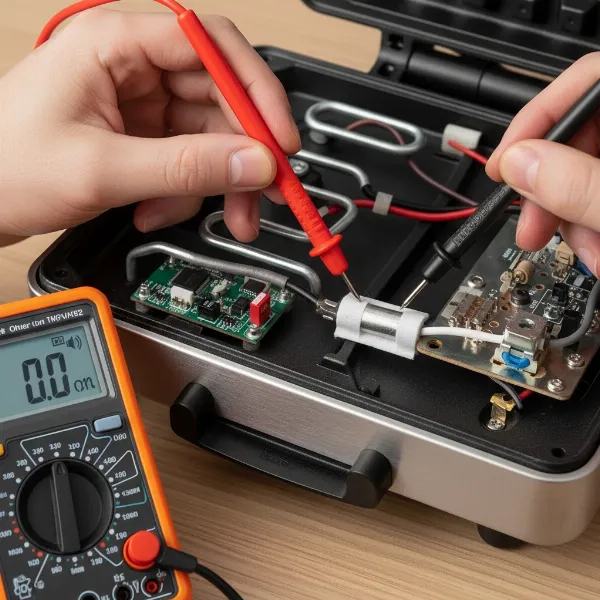 Person using a multimeter to test the continuity of a thermal fuse inside a disassembled waffle maker.
Examine the Heating Element
The heating element is what physically generates the heat.
- Locate Elements: There will typically be two heating elements, one for the top plate and one for the bottom. They are usually coiled wires or metallic strips embedded within the cooking plates.
- Test Resistance with a Multimeter: With the waffle maker unplugged and cooled, disconnect the wires leading to the heating element (take a picture first). Set your multimeter to the ohms (Ω) setting. Place one probe on each terminal of the heating element.
- Expected Resistance: A functional heating element should show a resistance reading, typically between 3 and 30 ohms, depending on the wattage of your appliance.
- No Resistance (OL): If your multimeter shows an “OL” (open line) or infinite resistance, the heating element has an internal break and is faulty. If only one element is bad, only one plate will heat.
- Zero Resistance: A reading of 0 ohms might indicate a short circuit, which is also a fault.
Check the Thermostat/Temperature Control
A malfunctioning thermostat can prevent heat generation.
- Locate Thermostat: The thermostat is often a bimetallic disc or a sensor with a control knob, typically found close to the heating plates to accurately sense temperature.
- Test Continuity: With the waffle maker unplugged and at room temperature, disconnect the thermostat from the circuit (take a photo!). Set your multimeter to continuity. At room temperature, most thermostats should show continuity (beeping or 0 ohms) as they are normally closed until a set temperature is reached. If it shows “OL” at room temperature, it’s likely stuck open and defective.
Inspect Internal Wiring and Connections
Finally, perform a visual check of all internal wiring.
- Look for Damage: Examine all wires, connectors, and solder points for signs of scorching, melting, corrosion, or looseness.
- Secure Connections: If you find any loose spade connectors, gently re-seat them. If wires are corroded or broken, they will need to be repaired or replaced, which might require soldering or proper crimping tools.
When to Repair, Replace, or Seek Professional Help
After performing these troubleshooting steps, you’ll have a better idea of what might be wrong with your waffle maker. The next question is whether to fix it, replace it, or call for help.
- Repairability: Many modern, inexpensive waffle makers are not designed for easy repair. Manufacturers often don’t sell individual replacement parts, and the components may be integrated in a way that makes disassembly and repair difficult or impractical.
- Cost-Effectiveness: Consider the cost of replacement parts (if available) and the time and effort you’ll invest in the repair. If the cost of parts plus your time approaches the price of a new waffle maker, replacement is often the more economical and less frustrating option. This is especially true if multiple components (like both the fuse and the thermostat or heating element) are faulty.
- Safety First: If you’re dealing with internal electrical components, and you’re not confident in your abilities, or if the repair involves bypassing safety features, it’s always best to err on the side of caution. An improperly repaired heating appliance can pose a serious fire hazard.
- Professional Help: For higher-end or built-in waffle makers, or if you’re simply uncomfortable performing the repair yourself, a qualified appliance repair technician might be able to help. However, be mindful of their labor costs compared to the appliance’s value.
Preventive Maintenance for Your Waffle Maker
Even if you can fix your waffle maker, or if you end up replacing it, adopting good maintenance habits can significantly extend its lifespan and prevent future heating issues.
- Proper Cleaning After Each Use: Always clean your waffle maker according to the manufacturer’s instructions. Batter spills and residue can accumulate around the heating elements or controls, potentially causing damage or hindering proper operation.
- Avoid Overfilling: Resist the urge to overfill the waffle plates with batter. Excess batter can overflow, seep into the internal components, and cause short circuits or corrosion, leading to heating failures.
- Careful Storage: Store your waffle maker in a dry, safe place where it won’t be knocked around. Avoid wrapping the power cord too tightly around the unit, as this can stress and damage the internal wires over time.
- Regular Visual Inspections: Periodically check the power cord and plug for any signs of wear and tear, and ensure all external parts are intact. Catching minor damage early can prevent more significant problems down the line.
In conclusion, a waffle maker that has stopped heating up can be a solvable problem, especially if the issue lies with the power supply or a readily identifiable component like a thermal fuse. By systematically troubleshooting and prioritizing safety, you can often diagnose the problem. Remember that while some repairs are straightforward, others may require expertise or make replacement a more practical and safer choice. Making informed decisions will ensure you continue enjoying delicious waffles for years to come.
What’s your go-to waffle topping when your machine is working perfectly?
Frequently Asked Questions
Why did my waffle maker suddenly stop heating?
Your waffle maker likely stopped heating due to a power supply issue (like a tripped breaker or faulty outlet), a blown thermal fuse, a broken heating element, or a defective thermostat. The thermal fuse blowing is a common safety response to overheating.
Is it safe to bypass the thermal fuse in a waffle maker?
No, it is absolutely not safe to bypass the thermal fuse in a waffle maker. The thermal fuse is a critical safety device designed to prevent fires by cutting off power if the appliance overheats. Bypassing it eliminates this protection and creates a serious fire hazard.
How can I tell if the heating element is broken?
You can test the heating element using a multimeter set to the ohms (Ω) setting. Disconnect the element and place probes on its terminals. A reading of “OL” (open line) or infinite resistance indicates a broken heating element. A functional element typically shows a resistance between 3-30 ohms.
Can a faulty thermostat stop a waffle maker from heating?
Yes, a faulty thermostat can definitely stop a waffle maker from heating. If the thermostat fails in an “open” position, it won’t allow electricity to flow to the heating element, effectively preventing the appliance from warming up at all.
Are waffle makers generally easy to fix?
The ease of fixing a waffle maker varies. Simple issues like power cord damage might be manageable for some, but internal component failures (like thermal fuses or heating elements) can be more challenging. Many modern, inexpensive models are not designed for user repair, and parts may be hard to find.
When should I just buy a new waffle maker?
You should consider buying a new waffle maker when the cost of replacement parts and your time significantly outweighs the price of a new unit, or if multiple major components have failed. Additionally, if the repair involves complex electrical work and you’re not confident in your skills, buying a new one is often the safer and more practical choice.